

 The Editor and the Book
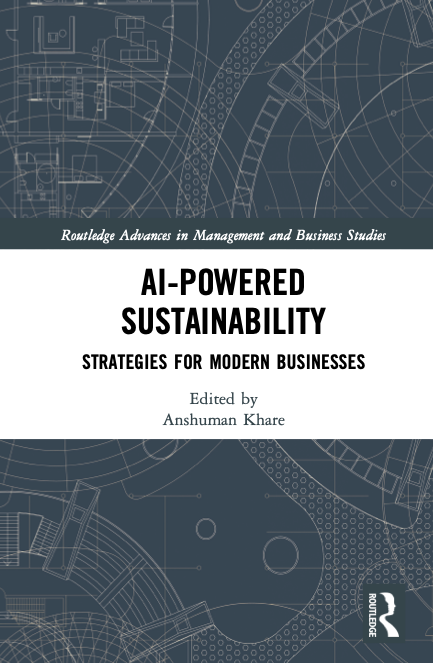
The intersection of Artificial Intelligence and sustainability is among the topics currently being intensively discussed in both academia and business practice. The editor, Anshuman Khare, is Professor of Operations Management at Athabasca University in Canada. He is an Alexander von Humboldt Fellow and completed postdoctoral positions at both Johannes Gutenberg University Mainz and Ryukoku University in Kyoto. His research focuses on supply chain management, sustainability, cities and climate change, and the digital transformation of business, among other areas. The edited volume “AI-Powered Sustainability: Strategies for Modern Businesses” will be published by Routledge (forthcoming) and brings together 15 chapters from international authors in academia and practice.
The central idea of the book is to systematically demonstrate the potential of AI technologies for sustainable business management. Rather than presenting abstract visions of the future, it focuses on concrete areas of application: from energy consumption optimization and intelligent waste management to AI-powered digital twins in production. The edited volume thus addresses a key question: How can companies leverage AI to achieve both economic and environmental objectives?
But let us delve into the contents…
The Contents
The book is divided into five thematic sections that offer different perspectives on the connection between AI and sustainability.
Section 1 – AI for Sustainable Business and Economic Development
The first section lays the conceptual foundation. Brian Stewart and Anshuman Khare open with a commentary on the role of AI in internalizing sustainability externalities – an economically grounded perspective on market distortions and their correction. Masatoshi Hara examines partnerships between higher education institutions, business, and government in Southeast Asia, demonstrating how AI can drive sustainable development in emerging economies. Thilini Mudiyanse, Sara Fraccastoro, and Arto Ojala address the largely unexplored potential of AI and sustainability in international marketing for small technology firms. Deborah Dull and Ann Tracy conclude the section with a practice-oriented look at AI-driven sustainability initiatives at consumer packaged goods companies.
Section 2 – AI for Sustainable Urban and Transport Systems
The second section focuses on urban systems and mobility. Anshuman Khare and Abubaker Haddud analyze AI-powered waste management in smart cities – from intelligent sensors to predictive analytics. Eldrige de Melo and Arto Ojala connect AI with space technology, showing how Earth observation data can be utilized for sustainability goals. Anshuman Khare and Marta Massi examine how AI can make carpooling more efficient and attractive.
Section 3 – AI’s Role in Energy Efficiency and Industrial Sustainability
The third section addresses energy efficiency and industrial applications. Robert Refvik describes how AI-based energy optimization and the integration of renewable energy deliver tangible benefits to businesses. Rodney Beard provides a practice-oriented guide for managers on measuring energy consumption and emissions from AI systems. Tomoyasu Saigo and Nobutaka Odake present a case study on the use of AI technology for consistent quality assurance in industrial manufacturing.
Section 4 – AI and Sustainable Manufacturing, Design, and Production
The fourth section is devoted to manufacturing and design. Marta Massi and Terry Beckman develop a framework for AI-powered digital twins in the context of Industry 5.0 and the UN Sustainable Development Goals. Iain Reid, Marina Papalexi, Jamie Laird, and Rosie Cripps use the footwear industry to demonstrate how mass personalization through AI can be designed sustainably. Hoe Chin Goi, Ray Tak-yin Hui, and Jose Baptista examine the integration of AI into design thinking processes for sustainability innovation.
Section 5 – AI for Sustainable Technology Innovation and Research
The concluding section also takes a critical stance. Deborah Dull poses the provocative question of whether AI itself can be circular, analyzing the material footprint of AI infrastructure – from water consumption and energy demand to growing e-waste. Nobutaka Odake rounds off the volume with application examples from various industrial fields.
The Verdict
The edited volume offers a broad and well-structured overview of the diverse applications of AI in the context of corporate sustainability. The thematic range – from conceptual foundations and urban systems to critical reflections on the ecological footprint of AI itself – makes the book a valuable resource. Particularly noteworthy is the successful blend of academic rigor and practical relevance: several chapters are authored by practitioners or based on concrete case studies.
For my taste, I would have appreciated an even deeper engagement with the limitations and risks of AI applications in some places – for instance, regarding data privacy, algorithmic bias, or dependence on large technology providers. However, this does not diminish the overall value of the work: the critical perspective in Deborah Dull’s contribution on the circularity of AI demonstrates that the editor also allows for uncomfortable questions.
Thus, the book is recommended to executives, sustainability officers, and consultants who wish to gain a well-founded overview of the potential of AI for sustainable business management. Researchers working at the intersection of technology and sustainability will also find valuable points of connection in this volume.
Note on transparency: The author was also a member of the Editorial Board for this edited volume. The author’s opinion is not influenced by this.



Leave A Comment